
As Sri Lanka accelerates its digital transformation, the demand for robust and scalable data infrastructure has never been greater. From modern data centers in Colombo to enterprise server rooms and telecommunications exchanges across the island, the backbone of this connectivity relies on clean, manageable, and secure fiber optic cabling. At the heart of this organized chaos lies a critical component: the fiber patch panel. Often called the “nerve center” of a fiber network, patch panels are not merely passive enclosures; they are the strategic foundation for reliable connectivity, easy maintenance, and future growth. When planning a network build, understanding the value and factors influencing Fiber Patch Panel prices in Sri Lanka is key to making a sound investment. This guide explores their pivotal role and highlights key solutions from leading global manufacturers.
Understanding Fiber Patch Panels: The Central Hub of Your Network
A fiber optic patch panel is a mounted hardware unit that provides a centralized location for terminating, splicing, and interconnecting fiber optic cables. It acts as the primary interface between the static infrastructure cabling (the “horizontal” or “backbone” cables) and the active networking equipment like switches and routers via patch cords. In Sri Lanka’s dynamic and often space-constrained technical environments, a well-chosen patch panel delivers immense value:
Organization & Management: It neatly houses and protects fragile fiber splices and connectors, preventing tangles and physical damage.
Scalability: It allows for easy reconfiguration, testing, and upgrades without disturbing the main cable runs.
Troubleshooting: Clearly labeled ports drastically reduce the time and cost associated with identifying and fixing network issues.
Professional Standards: Implementing patch panels is a best practice that ensures compliance with industry standards, enhancing overall network reliability and performance.
Key Selection Criteria for Patch Panels in the Sri Lankan Market
Choosing the right patch panel is a strategic decision for any network manager or system integrator in Sri Lanka. Several factors must be considered to match the panel to your specific application and environment, which collectively determine its value proposition:
Rack Unit (RU) Size: The most common sizes are 1U and 2U, which fit standard 19-inch racks. A 1U panel is ideal for space-efficient deployments with lower port counts, while a 2U panel offers higher density and capacity for core installations, often at a different price point.
Port Type and Density: The panel must accommodate the connector type you use—predominantly LC for high density or SC for robust, standard connections. Port density (e.g., 12, 24, 48 duplex ports) is a primary driver of cost and functionality.
Included Components: Panels are often sold with or without splice trays/cassettes and adapters. A panel with a splice cassette is designed for terminating and splicing loose cables directly, offering a clean, permanent solution and affecting the overall cost.
Build Quality and Accessibility: Features like sturdy metal construction, clear labeling fields, easy-access doors or slides, and efficient cable management rings are crucial for long-term durability and ease of use in Sri Lanka’s climate, and are reflected in product quality.
Manufacturer Reputation: Sourcing from established international brands guarantees adherence to precise manufacturing tolerances and material quality, which protects your network investment over time.
High-Density LC Connectivity: The A&G 1U LC 12 Duplex Panel (117-10124)
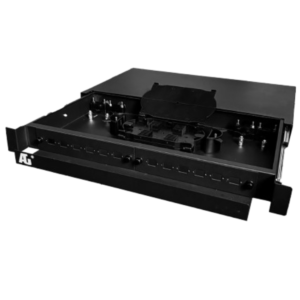
For networks prioritizing space efficiency and modern high-speed protocols, the LC connector is the industry standard. The A&G (France) 19′ 1U Fiber Optic Patch Panel LC 12 Duplex Port with Splice Cassette without Adapters (117-10124) exemplifies precision engineering for enterprise applications.
This 1U panel is engineered to support up to 24 fibers (12 duplex LC ports) in a compact form factor, making it perfect for corporate server rooms, financial institution data closets, or any installation where rack space is at a premium. The inclusion of a splice cassette allows for direct termination of incoming fiber cables, creating a robust and permanent connection point. The “without adapters” configuration offers system integrators in Sri Lanka the flexibility to install high-performance UPC or APC LC adapters based on the specific network requirement. A&G’s commitment to quality ensures reliable performance, easy maintenance, and long-term value.
Robust SC Standardization: The A&G 1U SC 12 Duplex Panel (117-10224)
Where ruggedness and widespread compatibility are key, the SC connector remains a trusted workhorse. The A&G (France) 19′ 1U Fiber Optic Patch Panel SC 12 Duplex Port with Splice Cassette without Adapters (117-10224) provides a reliable and organized termination solution for a wide array of network deployments.
This panel offers the same superior 1U, 12-duplex-port design but configured for SC connectors. It is an excellent choice for telecommunications infrastructure, older enterprise network upgrades, or any environment utilizing SC-based equipment. The sturdy push-pull latching mechanism of SC connectors is well-suited for panels that may require less frequent re-patching. Like its LC counterpart, it comes with a splice cassette for direct cable termination and is supplied without adapters, allowing for customization. This model ensures that networks across Sri Lanka requiring SC connectivity can be built with a high level of organization and French-engineered reliability.
High-Capacity Core Solution: The Dintek 2U LC 48 Duplex Panel
In large-scale deployments such as Internet Service Provider (ISP) headends, central office data halls, or large corporate data centers, port density and scalability are paramount. The Dintek (Taiwan) 19′ 2U Fiber Optic Rackmount Patch Panel LC 48 Duplex Port (4×12 Duplex LC) With Splice Cassette Without Adapters is built to meet this high-capacity demand.
This 2U panel is a powerhouse, designed to manage a remarkable 96 fibers through 48 duplex LC ports, organized into four manageable 12-port segments. This modular internal design simplifies cable routing, splicing, and future maintenance. The inclusion of a splice cassette makes it ideal for terminating high-fiber-count backbone cables entering the rack. Dintek’s reputation for delivering durable and cost-effective solutions makes this panel a strategic choice for Sri Lankan network builders who need to maximize their rack space while maintaining a clear, organized, and accessible fiber plant, offering significant capacity for the investment.
Building a Future-Proof Network Foundation in Sri Lanka
Selecting the right fiber patch panel is a foundational decision in network design. It directly impacts operational efficiency, troubleshooting speed, and the ease of scaling the network to meet tomorrow’s demands. Whether you require the space-saving precision of an A&G 1U LC panel, the robust standardization of an A&G 1U SC panel, or the massive capacity of a Dintek 2U LC panel, the choice dictates the manageability and professionalism of your entire fiber infrastructure. For Sri Lankan businesses and service providers investing in a digital future, integrating these organized, high-quality patch panels is not an expense but an investment in reduced downtime, lower operational costs, and a network that can grow seamlessly with the nation’s ambitions. By centralizing and protecting critical connections, you build a stronger, smarter, and more resilient backbone for progress.