An automatic transfer switch (ATS) helps critical equipment remain powered when its primary electrical source fails. In a server rack, it can transfer a supported load to a second source, such as a separate UPS output or supply feed. The right model depends on the equipment’s input design, power draw, plug types and the availability of a genuinely independent backup source. This guide explains how to compare an automatic transfer switch in Sri Lanka and prepare a compatible rack installation.
ATS devices do not create backup power. They switch between two inputs, so both sources must be available and sized for the connected load. Map which devices need continuity, check whether they have single or dual power supplies, and confirm whether a rack ATS is the correct solution for your setup. Browse the automatic transfer switch category to compare the listed models and confirm current specifications.
How an automatic transfer switch works
A rack ATS monitors its source inputs and supplies the connected equipment from its preferred source under normal conditions. If that input becomes unavailable or moves outside the device’s accepted range, the switch transfers the output to the alternate input. Transfer behaviour, detection thresholds and switching time vary by model. Read the manufacturer specifications and confirm that connected equipment can tolerate the transfer characteristics.
For a server with two power supplies, each supply may connect to a different PDU or power path. For a single-cord device, a rack ATS can provide an alternate source, but it still leaves one output path downstream. Understand the full chain: utility, UPS, circuit, PDU, ATS, cabling and load. A second input is only useful when the upstream source has enough capacity and is sufficiently independent.
Check load, voltage and input connections
List the rated input requirements of every device that will connect to the ATS. Add the expected load, include start-up demand where relevant, and leave headroom for growth. Check voltage, frequency, current rating, phase and connector type on both the ATS and site supply. The product’s maximum rating is not a target for continuous operation. A qualified electrician should verify the circuit, plug compatibility, earthing and protective devices before installation.
Also check output outlet types and counts. A rack switch with C13 outputs may not serve equipment requiring C19, and adapters can introduce fit or rating problems. Confirm cord length, cable reach and rack depth so the source cords do not cross ventilation paths or become strained when equipment is serviced.
Compare automatic transfer switch options
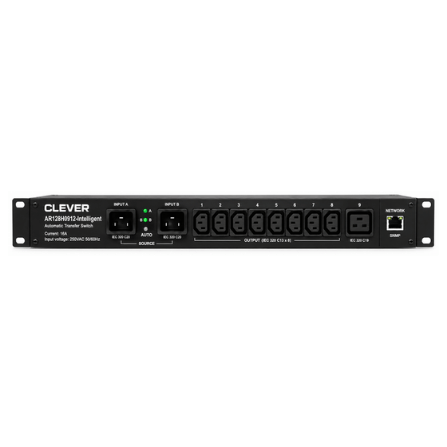
Clever (China) Intelligent 1U 16A Automatic Transfer Switch with SNMP Support – AR128H0912-Intelligent (3Y)
This intelligent 1U model is listed with an input rating of 16A and network management through SNMP. Remote monitoring can help infrastructure teams see device status and incorporate alerts into an existing monitoring system. Before choosing it, confirm both source connectors and their circuits, the output layout, management network requirements and the exact transfer specifications. Configure secure credentials and restrict management access to authorized systems. Its listed warranty is three years; verify warranty terms and included accessories with Richcom.
Clever (China) Basic 1U 16A Automatic Transfer Switch with 8 C13 and 1 C19 Outlets – AR128H0912-Basic (3Y)
The basic model is also a 1U, 16A rack ATS. Its listed output provides eight C13 outlets and one C19 outlet, which can suit a mix of compatible IT equipment when the combined load remains within the device rating. Compare that outlet arrangement with your device plugs and cable plan. Check source switching behaviour, status indicators, input connections, bypass or service arrangements and the manufacturer’s operating limits before installation. The product listing states a three-year warranty.
Choose between local and network monitoring
Monitoring needs depend on where the rack is installed and how quickly staff can respond. A basic unit may be adequate in a small, attended server room with local status checks. SNMP support can suit distributed sites or a network operations team that already monitors power devices centrally. Confirm the supported monitoring features, alert options, management interface and network security requirements rather than assuming that every model offers the same remote functions.
Network management should be treated like any other infrastructure endpoint. Change default credentials, place it on an appropriate management network, limit who can reach it and document the configuration. Test alerts and escalation paths after commissioning so an alarm leads to a clear operational response.
Automatic transfer switch installation and commissioning checklist
- Identify the critical loads and calculate their combined expected demand.
- Confirm input voltage, frequency, current, plug type and output connectors.
- Verify that the two power sources are suitable and have adequate independent capacity.
- Check transfer time and source selection behaviour against equipment requirements.
- Confirm rack space, airflow clearance, cord reach, cable routing and outlet access.
- Arrange qualified electrical review for circuits, protection and earthing.
- Label both sources and each output, then document which devices depend on the ATS.
- Test a controlled source-failure scenario and verify alarms, transfer and recovery.
Common automatic transfer switch selection mistakes
A common error is connecting both ATS inputs to the same upstream circuit and expecting source redundancy. Another is choosing by outlet count alone without checking total load, connector type or switching characteristics. Avoid routing both cords through one overloaded PDU, and do not assume a UPS provides unlimited runtime. Check battery condition, runtime at the actual load and the maintenance plan. Finally, make sure a staff member knows how to inspect alarms and restore normal operation.
Frequently asked questions about rack ATS devices
Does an ATS replace a UPS?
No. A UPS stores energy and can provide ride-through during an interruption. An ATS selects between two input sources. They may be used together when their ratings and operating design are compatible.
Can I connect any two power sources?
No. Confirm that both sources meet the ATS input requirements and follow the manufacturer’s installation instructions. Have a qualified professional verify the electrical arrangement.
What is the value of SNMP on an ATS?
SNMP can expose status or alerts to compatible network monitoring systems. Check the exact model’s supported data and secure the management interface.
How many devices can one rack ATS power?
Outlet count is only one limit. The combined load, voltage, current rating, outlet types and source capacity must all support the connected devices.
Compare the load and source plan before choosing a unit. A properly specified ATS can strengthen a rack power design when it is paired with suitable source capacity, compatible connectors and a tested response process.
For a manufacturer overview of how rack ATS units support single-corded equipment with alternate power sources, see Eaton’s ATS rack PDU guide.