Server rack locks help control physical access to equipment, side covers and cable connections. Choosing the right hardware means matching the lock to the door or panel cut-out, rack model and access policy. This guide compares selected server rack locks and security accessories in Sri Lanka and explains how to plan them as part of a wider physical security process.
Locks help deter casual access, but they do not replace access monitoring, room security or documented key control. NIST’s Physical and Environmental Protection controls describe security measures for facilities and equipment; see the NIST SP 800-53 security and privacy controls for broader context. Apply the controls appropriate to your organisation and follow the rack maker’s installation instructions.
Identify what needs to be secured
Start by listing the access points on the cabinet. Front and rear doors may use different latches. Side panels may have their own locking kit, and a blanking plate may require a separate lock. Record the rack series, door type, panel thickness, existing handle and cut-out shape. A lock that fits one enclosure may not fit another even if both cabinets use standard equipment rails.
Decide who needs access and how it should be granted. A service team may need shared emergency access, while a sensitive equipment room may need named key holders and access records. Keep spare keys in a controlled place, document key issue and return, and update the record when staff or contractors change. Consider whether keyed-different or keyed-alike locks better fit the policy.
Keyed-different, keyed-alike and material choices
Keyed-different locks use separate keying so one key does not normally operate every lock in a set. This can support compartmentalised access, although the key inventory becomes more complex. Keyed-alike systems can simplify access for authorised staff, but a lost key may affect several cabinets. Confirm the actual keying arrangement with the supplier and avoid assuming that a lock’s name guarantees a specific key code.
Material and construction also matter. A polyamide lock and a steel lock may differ in durability, appearance and suitability for the enclosure. Compare the manufacturer’s material details, dimensions, environmental conditions and service requirements. Do not judge security from material alone; the door, frame, latch, installation and room controls all affect the result.
Check lock fit and installation details
Before ordering, compare the lock body, panel thickness, fixing method and cam or latch arrangement with the rack. Verify the cut-out dimensions and any required adapter or handle. Confirm whether the product is a complete lock assembly or one component in a larger handle. Check which keys, screws, washers and plates are included.
Installation should not weaken the door or side panel. Follow the rack maker’s approved mounting method and use the correct fasteners. Ensure the lock operates smoothly, the panel closes fully and the latch engages without forcing the handle. Test access using the authorised keys and document the model and keying arrangement. If the fit is uncertain, ask Richcom to confirm compatibility before modifying the enclosure.
Three rack lock options to compare
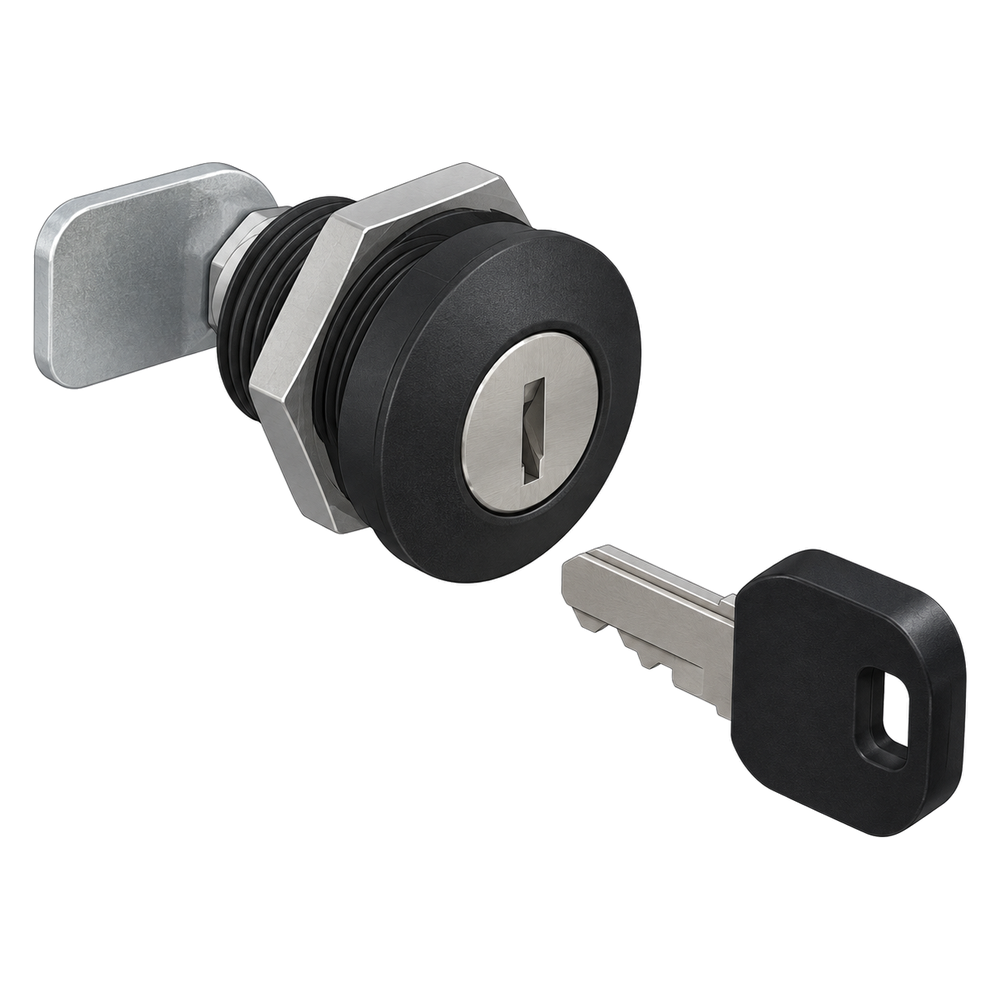
TIMIK (Canada) Key Lock Polyamide (Keyed Different) – KLP
The KLP is listed as a polyamide key lock with keyed-different configuration. It may be suitable where the compatible enclosure needs a lock of this style and separately keyed access is part of the site policy. Confirm the exact cut-out, panel thickness, locking mechanism and key arrangement. The rack manufacturer or supplier should verify that the lock is intended for the specific door or cover.
TIMIK (Canada) Key Lock Steel (Keyed Different) – KLS
The KLS is a steel key lock listed with keyed-different configuration. Compare its mounting dimensions and latch style with the KLP and with the rack’s existing lock. Ask for the current material and finish details if the installation has particular environmental or durability needs. Confirm whether the supplied keys can be managed in the planned access-control process.
TIMIK (Canada) Side Cover Internal Lock Kit – 19A SCILK
The SCILK is listed as a side-cover internal lock kit and has a stated thickness of 1.5 mm. It addresses a different enclosure access point from a standard key lock. Verify compatibility with the cabinet’s side-cover construction, the number of panels covered and the included parts. Make sure technicians can still remove the cover for service when they follow the approved access process.
Build a practical key-control procedure
Assign responsibility for keys and record who receives them. Store spare keys securely, label them without exposing sensitive cabinet information and maintain an up-to-date issue log. For shared keys, define when they may be used and how they are returned after work. Replace or rekey locks when a key is lost and the organisation’s risk assessment calls for it.
Pair physical locks with the room’s visitor and maintenance procedures. Identify who approves access, how work is logged and how emergency entry is handled. If an incident occurs, record which equipment or panels may have been accessed. These basic practices make a lock part of an operational control rather than an isolated accessory.
Rack lock installation checklist
- Record the rack brand, series, door and side-panel type.
- Measure the cut-out, panel thickness and mounting points.
- Choose keyed-different or keyed-alike to suit access policy.
- Confirm material, latch operation, included keys and fasteners.
- Verify the exact model with the rack manufacturer or supplier.
- Install using the approved method and avoid unapproved drilling.
- Test door closure and latch engagement with authorised keys.
- Log key holders, spares, maintenance and any rekeying event.
Common mistakes when choosing rack security hardware
One mistake is buying by the word “lock” alone. Lock bodies, swing handles, blanking kits and internal side-cover kits have different functions. Read the product type and confirm whether it is a complete mechanism. Another is assuming that any lock from a similar rack will fit. Door cut-outs and panel thicknesses vary, so verify dimensions before purchase.
Key management is easy to overlook. A keyed-different option can reduce shared-key exposure, but it also requires a more careful inventory. A keyed-alike system may be easier to operate, yet a lost key may affect multiple enclosures. Set a policy first, then confirm the available keying options.
Finally, a rack lock is one layer of physical security. Consider room access, monitoring, visitor logging and incident response as well. Review the procedure when equipment, staffing or site layout changes.
Frequently asked questions
Does a rack lock prevent all unauthorised access?
No. It can help control a specific door or panel, but room access, key handling, monitoring and operational procedures also matter.
What does keyed different mean?
It generally means locks in the configuration use separate keys rather than one key opening the entire set. Confirm the specific keying supplied for the product.
Can I replace only the lock cylinder?
That depends on the rack and handle design. Verify the replacement part, cut-out and latch compatibility with Richcom or the rack manufacturer before ordering.
Compare current server rack lock products
Review the available server rack locks and security products in Sri Lanka after documenting the rack and access requirements. Confirm the full model, panel fit, material, included keys and current availability with Richcom. A compatible lock and a clear key-control procedure help make rack access predictable and auditable.
Complete your rack installation
Network and Server Racks · Rack Power Distribution Units · Rack Shelves and Equipment Supports · Rack Cable Management · Rackmount Online UPS Systems
Check cabinet depth, mounting, equipment load and electrical connections for each component.