
Sri Lanka’s digital infrastructure is undergoing a transformative leap forward. From the high-rise data centers of Colombo’s financial district to the burgeoning tech parks in Kandy and the nationwide push for high-speed connectivity, the demand for reliable, high-bandwidth networks has never been greater. At the physical core of this revolution lies a critical component: fiber optic cables. Far more than just wires, these cables are the superhighways of light that carry data at incredible speeds, forming the essential foundation for everything from corporate cloud services and e-governance to education and entertainment. For project planners and procurement specialists, a key part of the planning phase involves understanding the factors that influence Fiber Optic Cable prices in Sri Lanka to budget effectively. This guide delves into the types, applications, and essential products from leaders like A&G (France) and Dintek (Taiwan) that are enabling this digital future.
Understanding Fiber Optic Cables: Light as Data
Unlike traditional copper cables that transmit electrical signals, fiber optic cables transmit data as pulses of light through incredibly thin strands of glass or plastic called optical fibers. This fundamental difference grants fiber optics unparalleled advantages that are critical for Sri Lanka’s growth:
Extreme Bandwidth & Speed: Capable of carrying vastly more data over longer distances with minimal signal loss, supporting next-generation applications.
Immunity to Interference: Unaffected by electromagnetic interference (EMI), making them ideal for industrial environments or running alongside power lines.
Enhanced Security: Tapping a fiber cable without detection is extremely difficult, offering a more secure data transmission medium.
Future-Proofing: Deploying the right fiber cable today, such as OM4 or single-mode, ensures your infrastructure can handle tomorrow’s data loads.
For network designers and IT managers in Sri Lanka, selecting the correct cable type—defined by fiber mode, connector type, and application—is the first and most crucial step in building a resilient and cost-effective network.
Key Cable Types and Applications in the Sri Lankan Market
Navigating the fiber optic cable landscape requires understanding a few core classifications, as the specifications directly impact performance and value. The right choice depends entirely on the specific use case, distance, and required performance.
By Fiber Mode:
Multimode Fiber (MMF): Designed for shorter distances, typically within buildings, campuses, or data centers. It has a larger core that allows multiple light modes to travel. Common grades are OM3 and the higher-performance OM4, which are optimized for cost-effective, high-speed links up to 550 meters.
Single-mode Fiber (SMF): Features a much smaller core for a single light path. It is used for long-distance telecommunications, ISP backbones, and connections between cities, spanning tens of kilometers with minimal loss, often representing a different segment of the market.
By Cable Construction & Use:
Patch Cords/Patch Cables: Short, flexible, pre-terminated cables with connectors on both ends (e.g., SC-SC, LC-LC). Used to connect devices to patch panels. Prices vary by length, connector type, and fiber grade.
Pigtails: Short cables with a connector on one end and bare, unterminated fiber on the other. They are spliced onto backbone cables for termination inside patch panels or closures.
Distribution & Armored Cables: The main “trunk” cables for indoor/outdoor runs. Armored variants with metal sheathing are essential for direct burial or installations where rodent damage or physical stress is a concern in Sri Lanka’s diverse environments, and constitute a major part of cable infrastructure investment.
High-Speed Data Center Links: A&G SC-LC Duplex OM3 Patch Cord
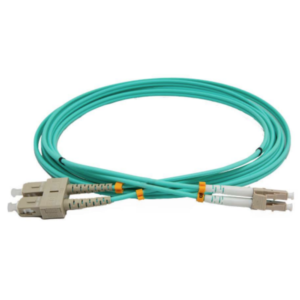
Within modern data centers and enterprise server rooms, efficient and high-density patching is paramount. The A&G (France) SC-LC Duplex Fiber Optic Patch Cord 50/125 MM OM3 is a perfect example of a hybrid cable designed for practical interconnectivity and value.
This duplex (2-fiber) patch cord features an SC connector on one end and an LC connector on the other. This is specifically designed to connect legacy equipment with SC ports to modern, high-density switches and routers equipped with LC ports. Built with 50/125μm OM3 multimode fiber, it is laser-optimized to support high-speed protocols like 10GbE, 40GbE, and 100GbE over the short reaches typical within a rack or between adjacent racks. For Sri Lankan businesses upgrading their core IT infrastructure in phases, this cable provides a reliable and performance-guaranteed bridge between equipment generations, ensuring seamless integration without sacrificing speed or requiring a complete overhaul.
Precision Termination: Dintek LC Pigtail 1M OM3 (2105-07007)
Reliable network termination begins with a quality pigtail. The Dintek (Taiwan) LC Pigtail 1M 50/125 MM OM3-2105-07007 is a fundamental building block for creating professional and low-loss connections in patch panels and splice closures.
This 1-meter pigtail is terminated with a high-precision LC connector on one end, ideal for high-density panels, while the other end presents bare fiber ready for fusion splicing. Using OM3 grade multimode fiber, it is designed to be spliced onto the end of a backbone distribution cable, providing a clean and reliable transition from the cable plant to the connectable interface. For system integrators and telecom engineers across Sri Lanka, using consistent, factory-polished pigtails like this Dintek model ensures superior connector quality, reduces on-site termination errors, and guarantees optimal performance for in-building networks and data center expansions, representing a cost-effective component for permanent links.
Optimized for Performance: Dintek SC-SC Duplex OM4 Patch Cord
For backbone connections within a high-performance computing environment or links that require the utmost bandwidth headroom, OM4 fiber is the multimode standard. The Dintek (Taiwan) SC-SC Duplex Fiber Optic 2M Patch Cord 50/125 MM OM4 is engineered to deliver this enhanced capability.
This is a standard duplex patch cord with rugged SC connectors on both ends, making it a versatile workhorse for connecting ports in patch panels, linking media converters, or interfacing with various active equipment. The use of OM4 multimode fiber provides superior performance over OM3, offering extended reach and higher margins for applications like 40G and 100G Ethernet. The 2-meter length offers flexible routing within racks. For Sri Lankan organizations deploying bandwidth-intensive applications, virtualized environments, or storage area networks (SANs), this Dintek OM4 patch cord provides a reliable, future-proof link that minimizes attenuation and maximizes data throughput, offering strong value for critical connections.
Choosing the Right Cable for Sri Lanka’s Network Future
The journey toward a fully connected Sri Lanka is paved with light. Selecting the appropriate fiber optic cable is not a generic decision but a strategic one that balances immediate needs with long-term scalability and overall project cost. Whether it’s enabling equipment interoperability with an A&G SC-LC hybrid patch cord, ensuring pristine termination with a Dintek LC pigtail, or future-proofing data center cores with a Dintek OM4 patch cord, each cable serves a distinct and vital purpose. Investing in quality cables from reputable international manufacturers is an investment in network stability, reduced downtime, and favorable total cost of ownership. As the nation continues to expand its digital footprint, the integrity of every meter of fiber—from the long-haul single-mode lines between cities to the last-meter patch cord in a server rack—will be fundamental to realizing a faster, more connected, and economically vibrant Sri Lanka.