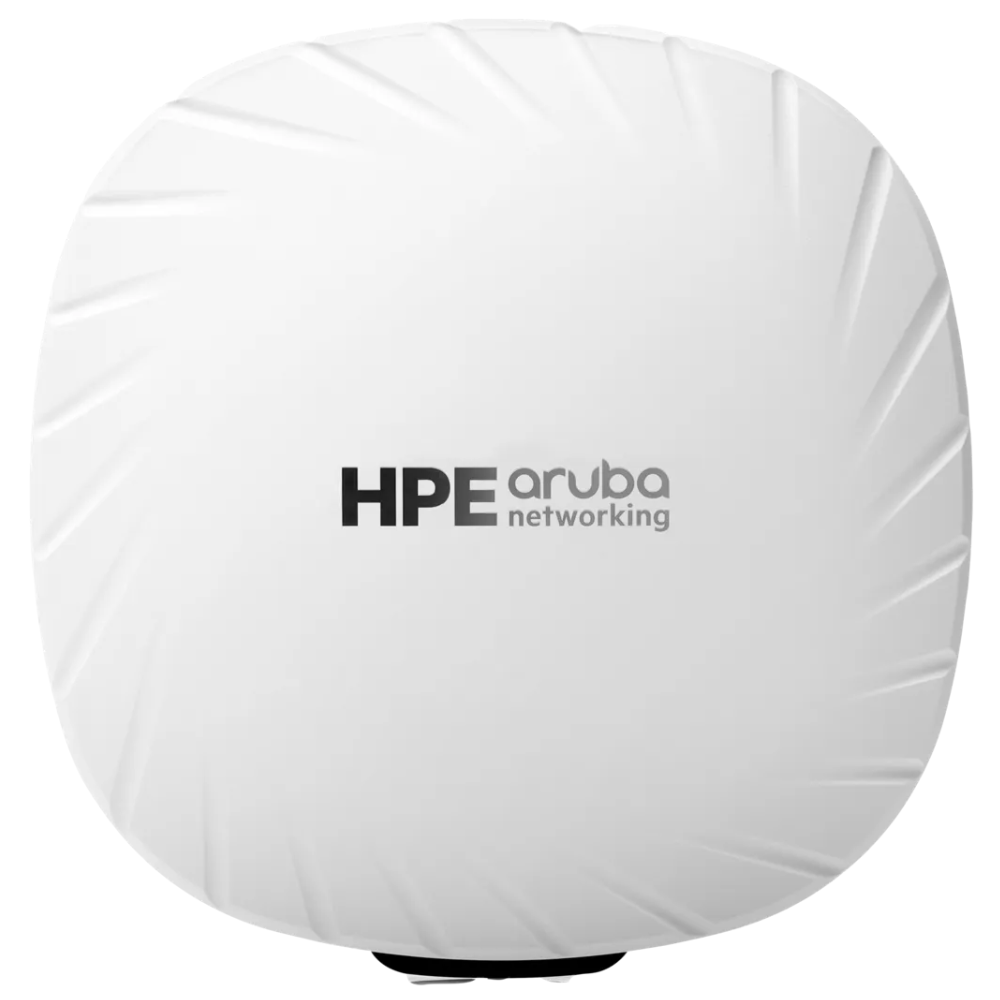
| AP-503: Campus AP platform, integrated antennas |
- AP type: Indoor, dual-radio, 2.4GHz and 5GHz (dual concurrent) 802.11ax 2×2 MIMO
- 2.4GHz radio: Two spatial stream Single User (SU) MIMO for up to 574Mbps wireless data rate with 2SS HE40 802.11ax client devices (287Mbps for HE20)
- 5GHz radio: Two spatial stream Single User (SU) MIMO for up to 1.2Gbps wireless data rate with 2SS HE80 802.11ax client devices
- Up to 256 associated client devices per radio, and up to 16 BSSIDs per radio
- Supported frequency bands (country-specific restrictions apply):
- 2.400 to 2.4835GHz ISM
- 5.150 to 5.250GHz U-NII-1
- 5.250 to 5.350GHz U-NII-2A
- 5.470 to 5.725GHz U-NII-2C
- 5.725 to 5.850GHz U-NII-3/ISM
- 5.850 to 5.895GHz U-NII-4
- Available bands and channels: Dependent on configured regulatory domain (country)
- Dynamic frequency selection (DFS) optimizes the use of available RF spectrum in the 5GHz band
- Supported radio technologies:
- 802.11b: Direct-sequence spread-spectrum (DSSS)
- 802.11a/g/n/ac: Orthogonal frequency-division multiplexing (OFDM)
- 802.11ax: Orthogonal frequency-division multiple access (OFDMA) with up to 8 resource units
- Supported modulation types:
- 802.11b: BPSK, QPSK, CCK
- 802.11a/g/n: BPSK, QPSK, 16-QAM, 64-QAM and 256-QAM (proprietary extension)
- 802.11ac: BPSK, QPSK, 16-QAM, 64-QAM, 256-QAM and 1024-QAM (proprietary extension)
- 802.11ax: BPSK, QPSK, 16-QAM, 64-QAM, 256-QAM and 1024-QAM
- 802.11n high-throughput (HT) support: HT20/40
- 802.11ac very high throughput (VHT) support: VHT20/40/80
- 802.11ax high efficiency (HE) support: HE20/40/80
- Supported data rates (Mbps):
- 802.11b: 1, 2, 5.5, 11
- 802.11a/g: 6, 9, 12, 18, 24, 36, 48, 54
- 802.11n: 6.5 to 300 (MCS0 to MCS15, HT20 to HT40), 400 with 256-QAM (proprietary extension)
- 802.11ac: 6.5 to 867 (MCS0 to MCS9, NSS = 1 to 2, VHT20 to VHT80); 1,083 with 1024-QAM (MCS10 and MCS11, proprietary extension)
- 802.11ax (2.4GHz): 3.6 to 574 (MCS0 to MCS11, NSS = 1 to 2, HE20 to HE40)
- 802.11ax (5GHz): 3.6 to 1,201 (MCS0 to MCS11, NSS = 1 to 2, HE20 to HE80)
- 802.11n/ac packet aggregation: A-MPDU, A-MSDU
- Transmit power: Configurable in increments of 0.5 dBm
- Maximum (aggregate, conducted total) transmit power (limited by local regulatory requirements):
- Per radio (2.4GHz / 5GHz): +21 dBm (18dBm per chain)
- Note: conducted transmit power levels exclude antenna gain. For total (EIRP) transmit power, add antenna gain.
- Advanced Cellular Coexistence (ACC) minimizes the impact of interference from cellular networks
- Maximum ratio combining (MRC) for improved receiver performance
- Cyclic delay/shift diversity (CDD/CSD) for improved downlink RF performance
- Space-time block coding (STBC) for increased range and improved reception
- Low-density parity check (LDPC) for high-efficiency error correction and increased throughput
- Transmit beam-forming (TxBF) for increased signal reliability and range
- 802.11ax Target Wait Time (TWT) to support low-power client devices
|
- AP-503: Integrated downtilt omni-directional antennas for 2×2 MIMO with peak antenna gain of 1.7dBi in 2.4GHz and 4.8dBi in 5GHz. Built-in antennas are optimized for horizontal ceiling mounted orientation of the AP. The downtilt angle for maximum gain is roughly 30 degrees.
- Combining the patterns of each of the antennas of the MIMO radios, the peak gain of the combined, average pattern is 1.5dBi in 2.4GHz and 3.9dBi in 5GHz.
|
- E0: Ethernet wired network port (RJ-45)
- Auto-sensing link speed (10/100/1000BASE-T) and MDI/MDX
- POE-PD: 48Vdc (nominal) 802.3af POE (class 3 or higher)
- 802.3az Energy Efficient Ethernet (EEE)
- USB 2.0 host interface (Type A connector)
- Capable of sourcing up to 100mA / 500mW to an attached device
- Built-in Trusted Platform Module (TPM) for enhanced security and anti-counterfeiting
- Visual indicators (two multi-color LEDs): for System and Radio status
- Reset button: factory reset, LED mode control (normal/off)
- Serial console interface (proprietary, micro-B USB physical jack)
- Automatic thermal shutdown and recovery function
|
- The AP supports Power over Ethernet (POE) on port E0
- Power sources are sold separately
- Maximum (worst-case) power consumption: 10.9W
- Maximum (worst-case) power consumption in idle mode: 4.7W
- Both numbers assume no power is drawn from the USB interface
- Drawing 0.5W from the USB interface increases max AP power consumption by up to 0.7W
|
| A generic mount bracket to attach the AP-503 to suspended ceiling rails ships with the AP. Alternate or spare brackets can be ordered separately. |
- Dimensions/weight (AP-503;):
- 196mm (W) x 183mm (D) x 67mm (H)
- 515g
|
- Operating conditions
- Temperature: 0C to +40C / +32F to +104F
- Relative humidity: 5% to 95%
- ETS 300 019 class 3.2 environments
- AP is plenum rated for use in air-handling spaces
- Storage conditions
- Temperature: -25C to +55C / +13F to +131F
- Relative humidity: 10% to 100%
- ETS 300 019 class 1.2 environments
- Transportation conditions
- Temperature: -40C to +70C / -40F to +158F
- Relative humidity: up to 95%
- ETS 300 019 class 2.3 environments
|
| Mean Time Between Failure (MTBF): 930khrs (106yrs) at +25C operating temperature. |
- FCC/ISED
- CE Marked
- RED Directive 2014/53/EU
- EMC Directive 2014/30/EU
- Low Voltage Directive 2014/35/EU
- UL/IEC/EN 60950
- IEC/EN 62368-1
|
- AP-503 (all models): APIN0503
|
- Wi-Fi Alliance (WFA):
- Wi-Fi CERTIFIED a, b, g, n, ac
- Wi-Fi CERTIFIED 6
- WPA, WPA2 and WPA3 – Enterprise with CNSA option, Personal (SAE), Enhanced Open (OWE)
- WMM, WMM-PS, Wi-Fi Agile Multiband
- Passpoint (release 2)
- Ethernet Alliance (POE, PD device, class 3)
|
- ArubaOS and Aruba InstantOS 8.11.1.0, ArubaOS 10.5.0.0
|




Reviews
There are no reviews yet.